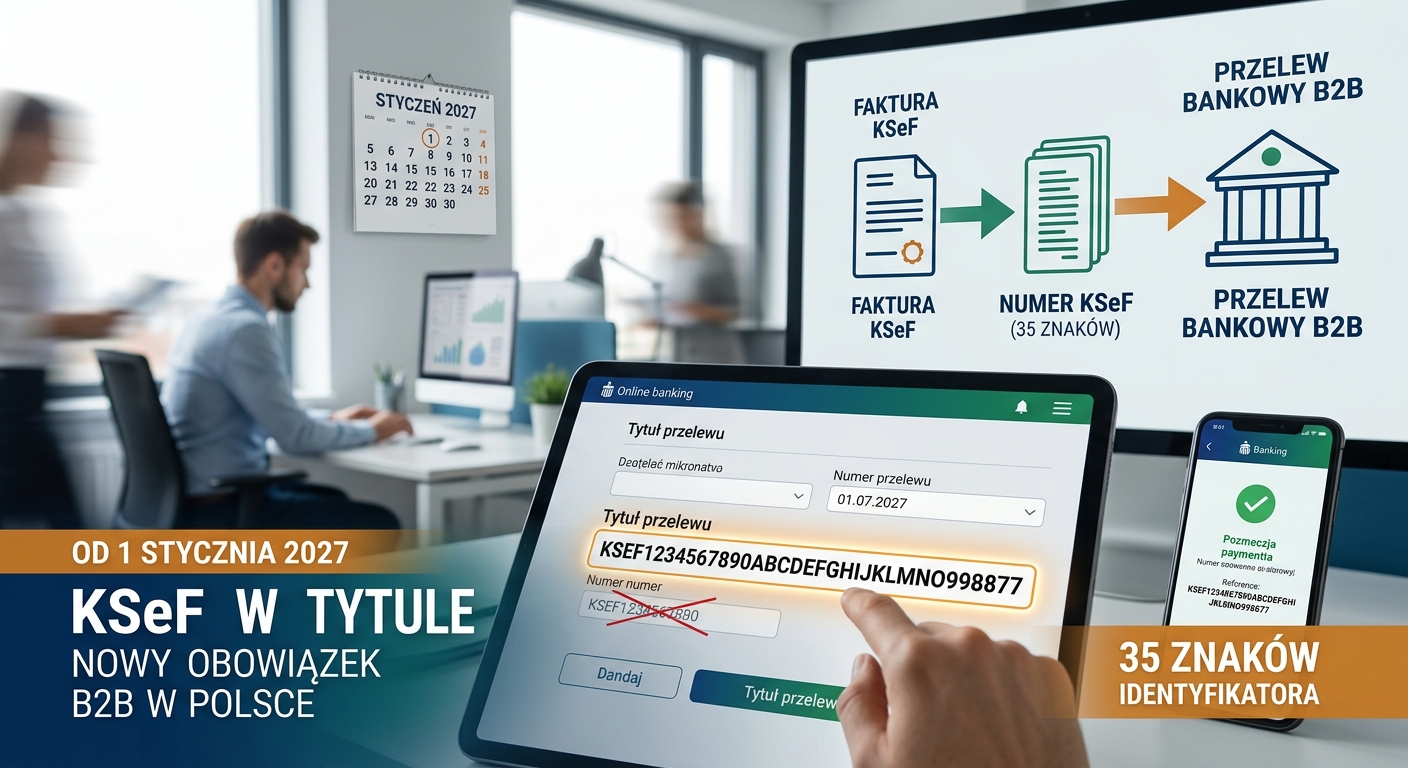
The 2027 KSeF Payment Shift: Why Your Bank Transfers Need a 35-Digit Upgrade
As businesses adapt to Poland’s National e-Invoicing System (KSeF), a critical compliance milestone arrives on January 1, 2027.
Starting on this date, referencing standard internal document numbers (like INV/2027/01/001) in payment titles will no longer satisfy VAT compliance rules for B2B transactions. Active VAT taxpayers will be required to include the system-assigned 35-character KSeF number or a KSeF collective identifier in the payment reference.
What Changes on January 1, 2027?
For active VAT taxpayers paying B2B invoices via payment methods that allow a payment reference (e.g., electronic bank transfers or Split Payment Mechanism / MPP):
Single Invoice Payments: You must include the full 35-character KSeF identifier directly in the bank transfer title.
Batch Payments: When paying multiple invoices from the same supplier at once, you must first request a Collective Identifier (identyfikator zbiorczy) directly through KSeF and reference that code in the payment description.
Key Exemptions
This requirement does not apply to:
Cash payments or point-of-sale card transactions.
Payments to non-VAT vendors or consumer (B2C) transactions.
Emergency or offline invoices where a system KSeF number has not yet been issued at the time of payment.
Preparing Your Finance Operations
Entering 35-character strings manually is slow and prone to errors. To prepare:
Update ERP Software: Ensure your accounting software automatically captures KSeF numbers on incoming invoices and maps them straight to payment batch export files (e.g., ISO 20022 formats).
Automate Collective Identifiers: Build workflows to generate and reconcile batch identifiers in KSeF automatically when settling multi-invoice balances.
Coordinate with Banking Partners: Test bank integration files ahead of time to verify that KSeF strings parse cleanly through processing workflows.
